
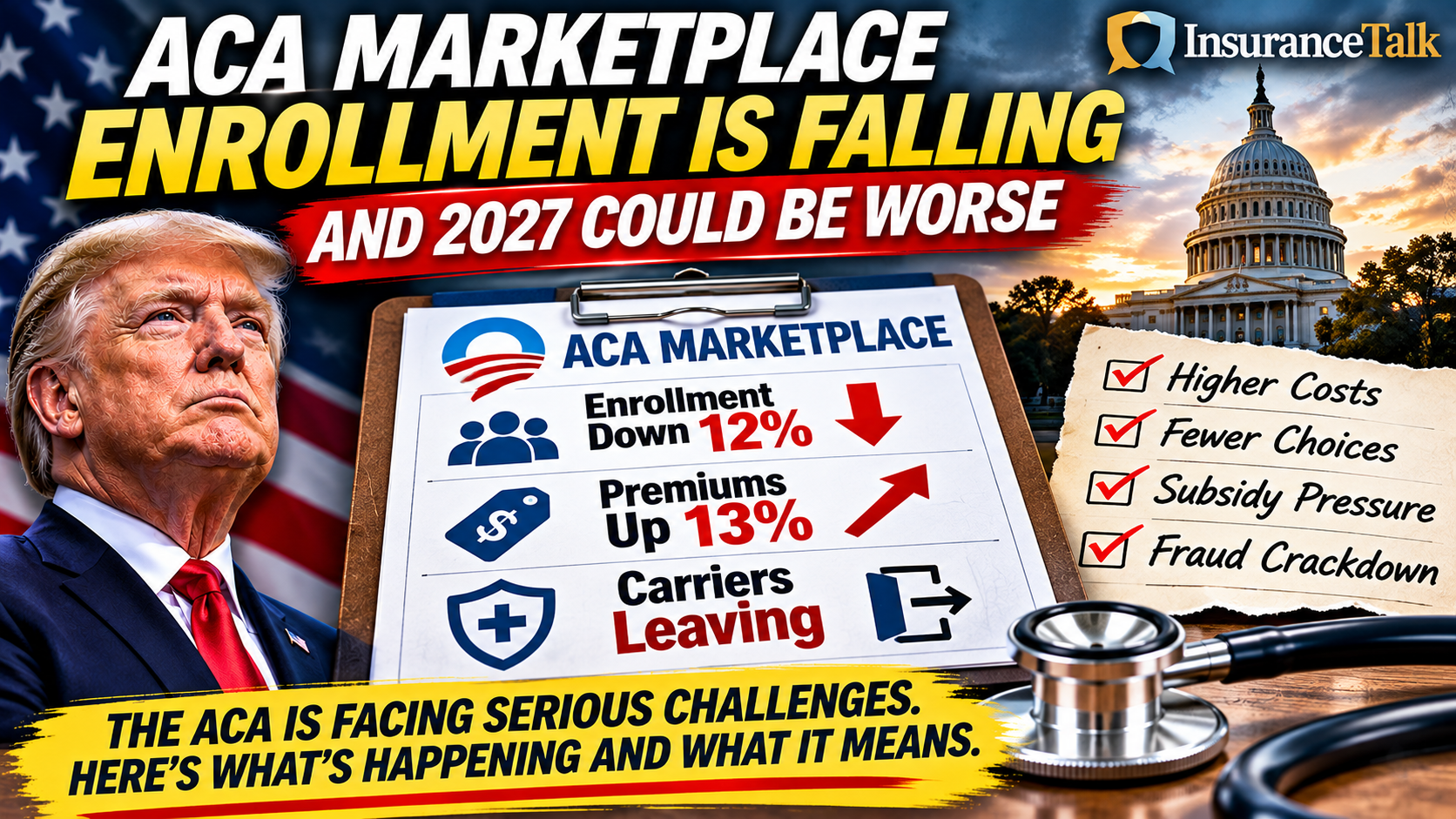
The Affordable Care Act was supposed to make health insurance affordable. Fifteen years later, premiums are still climbing, millions are leaving the Marketplace, and taxpayers are being asked to keep subsidizing a system that can't seem to control its own costs.
The Affordable Care Act is entering another difficult year, and the latest numbers aren't particularly encouraging.
According to a November 6 report from KFF, ACA Marketplace enrollment is declining, premiums are increasing again, and more insurance companies are preparing to exit the market.
And some of the numbers are pretty significant.
By February 2026, Marketplace enrollment had declined by 2.6 million people, a 12% reduction from the previous year.
Meanwhile, average benchmark Silver plan premiums are increasing another 13% for 2027, following a 26% increase in 2026.
That's roughly a 42% increase over two years.
And we're supposed to call this affordable healthcare?
I think these numbers expose a problem that has existed since the ACA was created.
We've spent years subsidizing the cost of health insurance without doing nearly enough to address why healthcare and insurance cost so much in the first place.
Now that some of those subsidies have expired, the underlying problem is becoming much harder to ignore.
Millions Are Leaving the Marketplace
KFF reports that ACA Marketplace plan selections declined by approximately 1.2 million during the 2026 Open Enrollment Period.
But that doesn't tell the entire story.
Selecting a plan and actually paying for it are two different things.
By February, effectuated enrollment, which measures people who have paid their premiums and maintained coverage, had fallen to approximately 19.2 million.
That's 2.6 million fewer people than the previous year.
The broader individual health insurance market, which includes both on-exchange and off-exchange coverage, experienced an even larger decline.
By June 2026, enrollment had fallen from 25.2 million to 20.5 million.
More than 4.6 million people.
And the Congressional Budget Office projects ACA Marketplace enrollment could decline to 13.1 million in 2027, compared with its peak of 22.4 million in 2025.
That's a projection, not an actual enrollment count. But it certainly isn't an encouraging outlook.
The Subsidies Were Hiding the Real Cost
One of the biggest reasons for declining enrollment is the expiration of the enhanced premium tax credits.
These additional subsidies were introduced during the COVID-19 pandemic and later extended through 2025.
They allowed many Americans to purchase Marketplace coverage at substantially reduced premiums.
Some paid little or nothing each month.
But here's the thing.
The insurance wasn't free.
The taxpayer was paying a significant portion of the bill.
When those enhanced subsidies expired, many consumers suddenly found themselves responsible for much larger premiums.
And some decided they simply couldn't afford the coverage anymore.
I understand the frustration.
For a family that was paying $200 per month and suddenly faces a substantially higher premium, that's a serious financial problem.
But I also think we need to ask an uncomfortable question.
If a health insurance product is only affordable when taxpayers pay most of the premium, have we actually made insurance affordable?
Or have we simply transferred the expense from the consumer to the federal government?
There's a difference.
And I think we've spent far too much time pretending those two things are the same.
Premiums Keep Increasing Anyway
The subsidy issue isn't the only problem.
The underlying price of health insurance continues to increase.
According to KFF, benchmark Silver premiums increased 26% in 2026 and are increasing another 13% in 2027.
Insurance companies cite rising medical costs, changes in enrollment and a deteriorating risk pool as contributing factors.
That last point is particularly important.
When premiums increase, healthier consumers are often the first to reconsider whether they can afford coverage.
But when healthier people leave, the remaining insured population tends to have higher medical expenses.
Insurance companies respond by increasing premiums to cover those costs.
Which can cause even more healthy people to leave.
It's a difficult cycle.
And once it starts, reversing it becomes increasingly challenging.
The ACA was designed partly to spread risk across a large population.
But if that population continues shrinking, the economics become more difficult.
Especially when the people leaving are disproportionately healthy.
Insurance Companies Are Starting to Walk Away
Another troubling development is the number of carriers leaving the Marketplace.
According to KFF, 11 insurance companies had announced plans to exit at least one state for 2027, while only seven announced plans to enter a new state.
Cigna is leaving the individual market entirely, withdrawing from all 11 states where it currently participates.
That's significant.
We hear a lot about the importance of competition in healthcare.
And I agree.
Competition is one of the best tools we have for encouraging innovation, improving service and controlling prices.
But competition becomes difficult when companies decide a market is no longer worth participating in.
Consumers in affected areas could find themselves with fewer insurance carriers, fewer provider networks and less flexibility when choosing coverage.
And when a market loses competition, consumers rarely benefit.

Trump Is Right to Crack Down on ACA Fraud
There's another part of this story that I think deserves some recognition.
The Trump administration has been taking a more aggressive approach toward fraud and improper enrollment in the ACA Marketplace.
And I support that effort.
In September, HHS announced that coverage had been canceled for approximately 760,000 individuals identified as potentially fraudulent or improper enrollments.
The administration had initially flagged approximately 1.2 million questionable enrollments for review.
These cases involved situations where brokers may have enrolled individuals without their knowledge, or where the government couldn't verify important eligibility information.
That's a serious problem.
Federal subsidies shouldn't be flowing to insurance companies for people who never authorized enrollment or don't meet eligibility requirements.
And taxpayers certainly shouldn't be funding fraudulent policies.
Now, there is an important distinction.
Not every enrollment flagged by the government has been proven fraudulent. Some legitimate consumers may have been caught in the process, and some have reportedly had coverage restored.
That needs to be corrected wherever it happens.
But the broader effort to identify fraudulent enrollments is absolutely necessary.
I applaud the Trump administration for taking it seriously.
Don't Punish Honest Agents for the Actions of Criminals
Where I disagree with the administration is its decision to temporarily freeze new ACA broker registrations.
CMS announced a moratorium that would have prevented approximately 19,000 new agents and brokers from registering during the restricted period.
The stated purpose was to address fraudulent enrollment activity.
I understand the objective.
But preventing legitimate agents from entering the market isn't the same thing as prosecuting the people committing fraud.
And a federal judge has since blocked the registration freeze through a preliminary injunction.
I think that's an important distinction.
Independent agents play a valuable role in helping consumers understand coverage options, verify eligibility and select appropriate plans.
We shouldn't be creating unnecessary barriers for honest agents because some bad actors have figured out how to exploit the system.
Identify the fraud.
Prosecute the criminals.
Recover the money where possible.
But don't make it harder for legitimate businesses to serve their customers.
That's not how we build a healthier insurance market.
The ACA Needs More Than Another Subsidy Extension
Predictably, some policymakers are arguing that the solution is to restore the enhanced subsidies.
And there's a legitimate argument that doing so would help millions of Americans afford their coverage.
It probably would.
But then what?
What happens when premiums increase another 10% or 15%?
Do we increase subsidies again?
And again?
At some point, we need to acknowledge that endlessly increasing government assistance isn't a sustainable substitute for controlling healthcare costs.
I'd rather see Washington focus on creating an environment where insurance companies have more room to compete, providers face fewer unnecessary administrative expenses, and consumers have meaningful choices.
That doesn't mean eliminating protections for people with preexisting conditions.
And it doesn't mean pretending everyone can afford coverage without assistance.
But it does mean recognizing that government subsidies cannot solve every problem in healthcare.
The Trump administration has an opportunity to push for meaningful reforms here.
Not simply another round of spending.
Actual reforms that address competition, healthcare pricing, transparency and the cost of delivering medical services.
That's where I'd like to see the conversation go.
The Bottom Line
The Affordable Care Act isn't disappearing tomorrow.
Millions of Americans still depend on Marketplace coverage, and many receive substantial financial assistance.
But the latest enrollment and premium figures should concern anyone paying attention.
Enrollment is falling.
Premiums are rising.
Insurance companies are leaving.
And the federal government continues struggling to control fraud and improper enrollment.
I support the Trump administration's efforts to bring accountability to the Marketplace and protect taxpayer dollars.
But I also believe the administration needs to be careful not to burden legitimate agents and consumers with unnecessary restrictions.
We need more competition, not less.
And we need a healthcare system that can function without requiring taxpayers to absorb an ever-increasing share of the cost.
The ACA was sold to Americans as a way to make health insurance affordable.
Fifteen years later, we're still trying to figure out how to accomplish that.
Maybe it's time to stop asking how much more government should spend subsidizing premiums.
And start asking why those premiums are so expensive in the first place.