
Anyone who has spent much time working with Medicare Advantage plans knows that one of the biggest headaches is figuring out which doctors actually accept which plans.
You look up a doctor in the insurance company's directory, and it says they're in-network. You call the doctor's office, and they tell you they don't accept that plan. Sometimes the doctor's office doesn't even know which Medicare Advantage products they're contracted with.
It's a problem that has been around for years, and apparently CMS has finally decided it needs more attention.
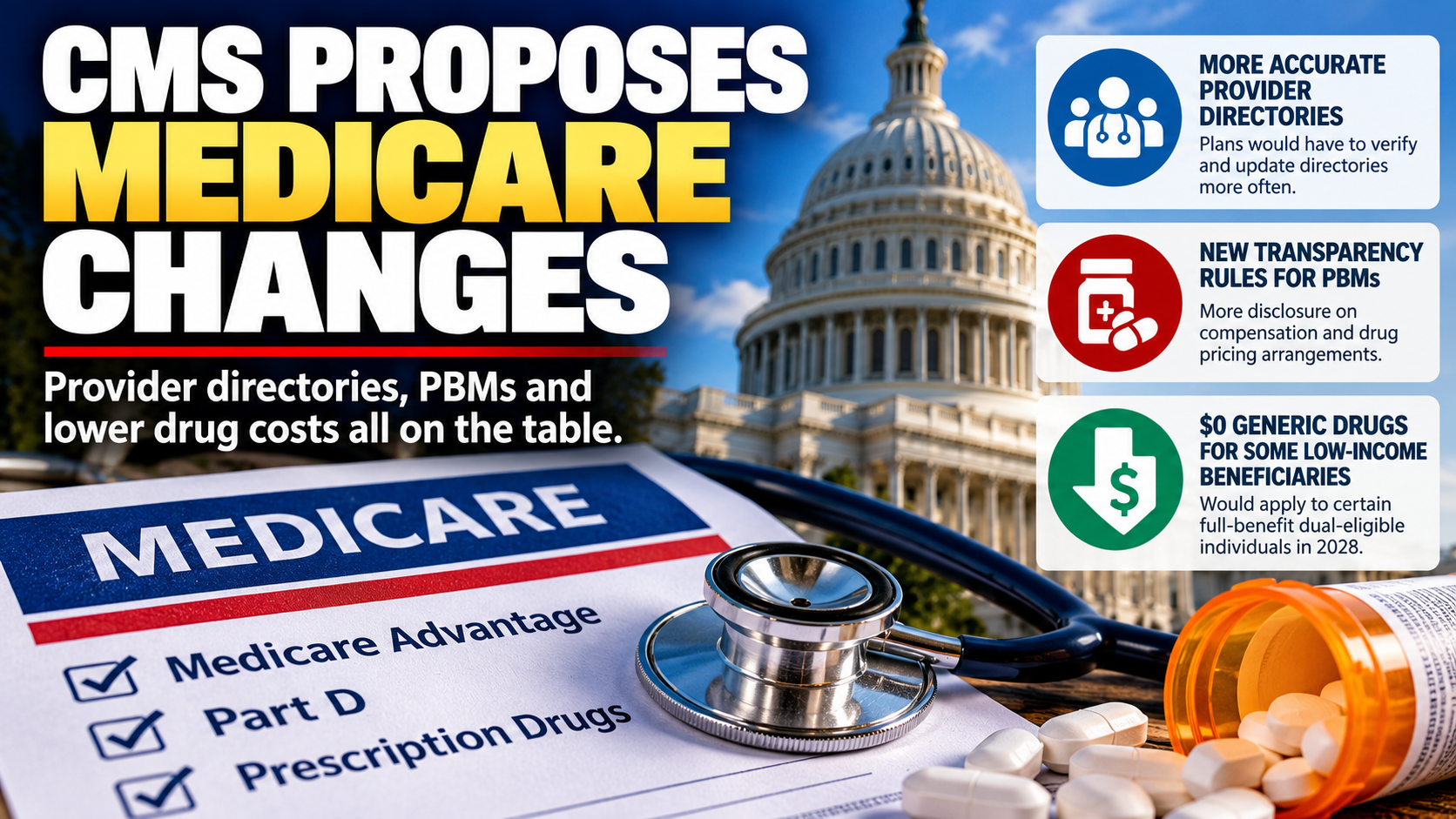
On October 16, the Centers for Medicare & Medicaid Services announced a proposed rule aimed at improving Medicare Advantage provider directories, increasing transparency among Pharmacy Benefit Managers (PBMs), and reducing certain prescription drug costs for low-income Medicare beneficiaries.
On the surface, these are some pretty reasonable changes.
But as with most government attempts to fix something, I think the real question is whether another set of regulations will actually solve the problem.
Medicare Advantage Provider Directories Could Finally Get Some Accountability
Probably the most interesting part of the proposal, at least from an insurance agent's perspective, involves provider directories.
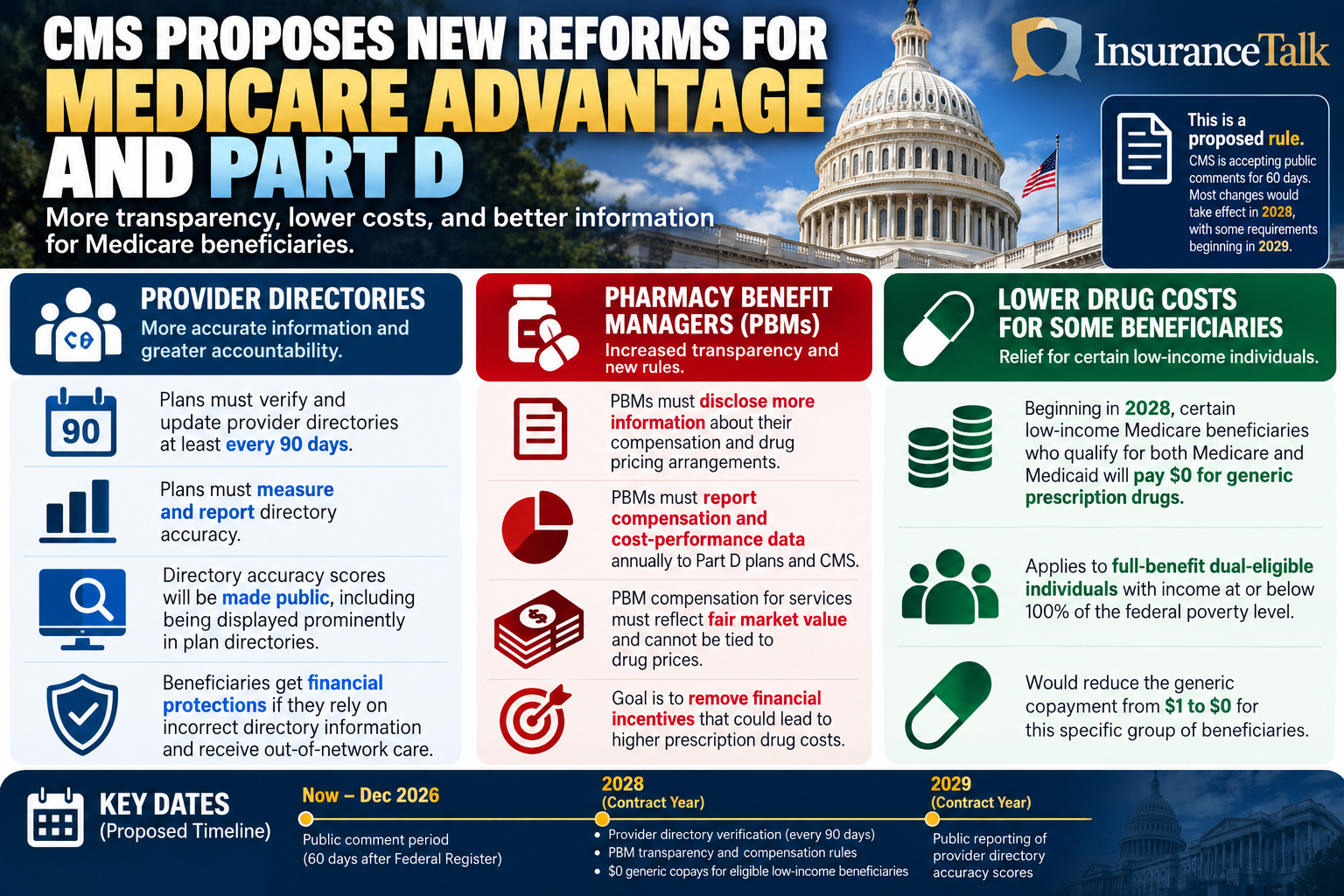
CMS wants Medicare Advantage insurance companies to verify and update their provider directories at least once every 90 days.
The proposal would also require plans to measure and report how accurate their directories are.
Eventually, those accuracy scores would be made available to the public, including being prominently displayed in the insurance companies' own provider directories.
I actually like this idea.
Imagine being able to compare two Medicare Advantage plans and see that one has a provider directory accuracy score of 98%, while another has a score of 82%.
That would be useful information for both consumers and agents.
Of course, those are hypothetical numbers, but you get the point.
Right now, agents spend an enormous amount of time trying to verify doctors. Even then, we often have to rely on information that turns out to be incorrect.
And when a beneficiary enrolls in a plan believing their doctor is in-network, only to discover otherwise after January 1, it's usually the agent who gets the phone call.
Under the proposed rule, CMS would also strengthen financial protections for beneficiaries who rely on incorrect directory information.
If someone receives care from an out-of-network provider because the insurance company's directory incorrectly listed that provider as in-network, the beneficiary would generally be protected from paying more than the applicable in-network cost-sharing amount.
That's a pretty significant consumer protection.
But I do have one concern.
Updating a directory every 90 days doesn't necessarily mean the information is accurate.
A doctor could terminate a contract the day after the directory is updated. A medical group might accept one product from an insurance company but not another.
And sometimes the problem isn't even with the insurance company. It's with the provider's office giving out incorrect information.
CMS can require insurance companies to verify their directories, but it still needs to figure out how to make that verification reliable.
Otherwise, we may end up with a lot more reporting and paperwork without much improvement in the actual information.
Pharmacy Benefit Managers Are Also in the Crosshairs
Another major part of the proposal involves Pharmacy Benefit Managers, commonly referred to as PBMs.
These are the companies that work behind the scenes administering prescription drug benefits for insurance companies.
They negotiate with drug manufacturers, manage pharmacy networks and help determine how prescription drugs are priced and reimbursed.
PBMs have become a major source of controversy in recent years, particularly over how they are compensated and whether their financial arrangements actually benefit consumers.
CMS is proposing new transparency requirements that would force PBMs to disclose more information about their compensation and drug pricing arrangements.
The proposal would require PBMs to report compensation and cost-performance information annually to Part D plan sponsors and CMS.
It would also place restrictions on how PBMs are paid, requiring compensation for services to reflect fair market value rather than being tied to drug prices.
The idea is to remove financial incentives that could encourage higher prescription drug costs.
And there is certainly an argument to be made for that.
If a middleman makes more money when the price of a drug increases, it's reasonable to question whether that arrangement is working in the consumer's best interest.
But here's where I become a little skeptical.
Prescription drug pricing in this country is already incredibly complicated, with manufacturers, wholesalers, PBMs, pharmacies and insurance companies all involved.
Adding another layer of federal oversight might improve transparency, but transparency by itself doesn't necessarily make something cheaper.
I would much rather see a market where insurance companies and PBMs have to compete aggressively on the actual cost of delivering prescription drugs.
If these regulations help accomplish that, great.
If they simply create another reporting system that ultimately gets passed along to consumers in the form of higher administrative costs, we haven't accomplished much.
Some Low-Income Medicare Beneficiaries Would Pay Nothing for Generic Drugs
There is also a smaller provision in the proposal that could make a meaningful difference for some Medicare beneficiaries.
Beginning in 2028, certain low-income individuals who qualify for both Medicare and Medicaid would see their generic prescription drug copayment reduced from $1 to $0.
This would apply to full-benefit dual-eligible individuals whose income is at or below 100% of the federal poverty level.
A dollar might not sound like much to most people.
But for somebody living on a very limited fixed income and taking several medications every month, even small expenses can add up.
Removing that copayment should provide some relief to those beneficiaries.
It's also worth pointing out that this isn't a proposal to eliminate generic drug copayments for everyone receiving Extra Help or everyone enrolled in a D-SNP.
It applies to a specific group of low-income beneficiaries.
These Changes Aren't Happening Tomorrow
One important detail that shouldn't get overlooked is the timeline.
Although CMS announced the proposal in October 2026, the primary changes are intended for contract year 2028, not 2027.
The provider directory accuracy reporting and verification requirements would begin in 2028, with additional public reporting requirements taking effect in 2029.
The generic drug copayment reduction is also scheduled for 2028.
And this is still a proposed rule.
CMS is accepting public comments for 60 days following publication in the Federal Register, meaning the final requirements could change before implementation.
The proposal largely implements provisions of the Consolidated Appropriations Act of 2026, which was signed into law earlier this year.
So while CMS is presenting these changes as part of its effort to improve Medicare Advantage and Part D, much of what we're seeing is the agency putting previously enacted legislation into regulatory form.
Will More Government Oversight Actually Fix the Problems?
I think there are some worthwhile ideas in this proposal.
Provider directory accuracy is a legitimate problem. I've dealt with it myself, and I suspect just about every Medicare agent has a story about a doctor who was supposedly in-network but wasn't.
PBM compensation is another area that deserves scrutiny.
But I also think we need to be careful about assuming that every problem in the insurance industry can be solved by giving CMS another regulation to enforce.
We already have an enormous amount of oversight in Medicare Advantage.
Insurance companies have to comply with network adequacy standards, marketing regulations, reporting requirements, benefit rules and countless other federal requirements.
Yet we still have inaccurate provider directories.
That should tell us something.
Sometimes the problem isn't that we need more rules. It's that the existing systems don't work particularly well.
And government agencies aren't exactly known for developing simple, efficient solutions.
I would like to see CMS focus just as much on making information accessible and usable as it does on requiring insurance companies to submit more reports.
For example, a standardized, publicly accessible provider directory system that agents and consumers could actually rely on would be far more valuable than another PDF explaining why directories are supposed to be accurate.
And if CMS is going to publish accuracy scores, those scores need to mean something. They should reflect whether a beneficiary can actually get an appointment with the doctor listed, not simply whether an insurance company checked a box saying it verified the information.
The Bottom Line
There is plenty of room for improvement in Medicare Advantage and Part D.
Consumers should be able to trust the provider directories they're using to select a health plan. They should have a better understanding of how prescription drug costs are determined.
And low-income beneficiaries shouldn't have to worry about whether they can afford essential medications.
Those are reasonable goals.
But the success of this proposal won't be measured by how many new regulations CMS publishes.
It will be measured by whether agents can finally trust the provider directories, whether beneficiaries experience fewer unexpected medical bills, and whether prescription drug costs actually become more affordable.
I'll give CMS credit for identifying some real problems.
Now we'll have to see whether Washington can actually fix them.