
For the past several years, it seems like every time you turn around, another insurance agency has been bought out.
Private equity firms have poured enormous amounts of money into the insurance industry, buying independent agencies and combining them into larger organizations. For agency owners looking to sell, it has created some pretty attractive opportunities.
But the latest numbers suggest the buying spree may finally be slowing down.
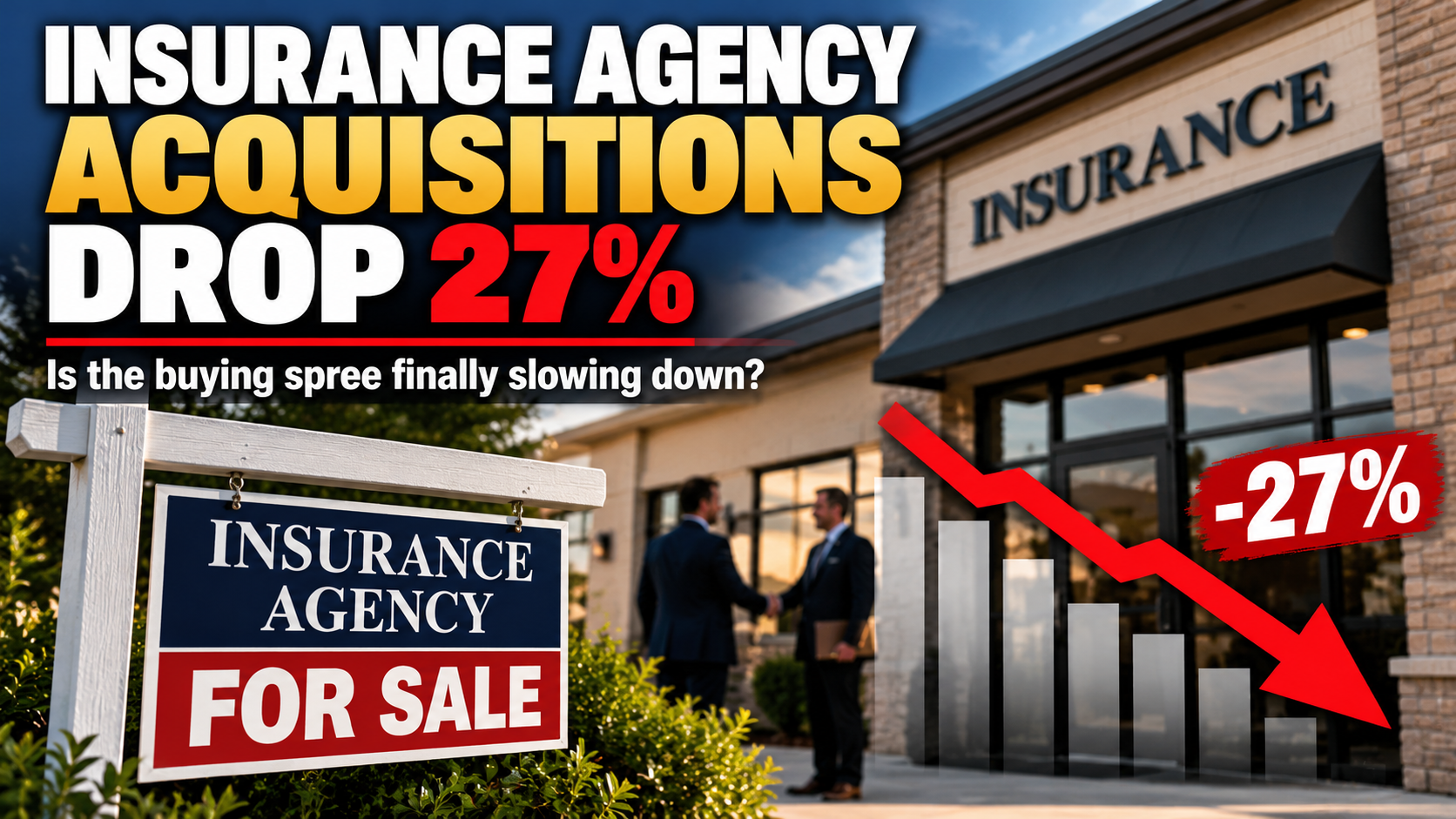
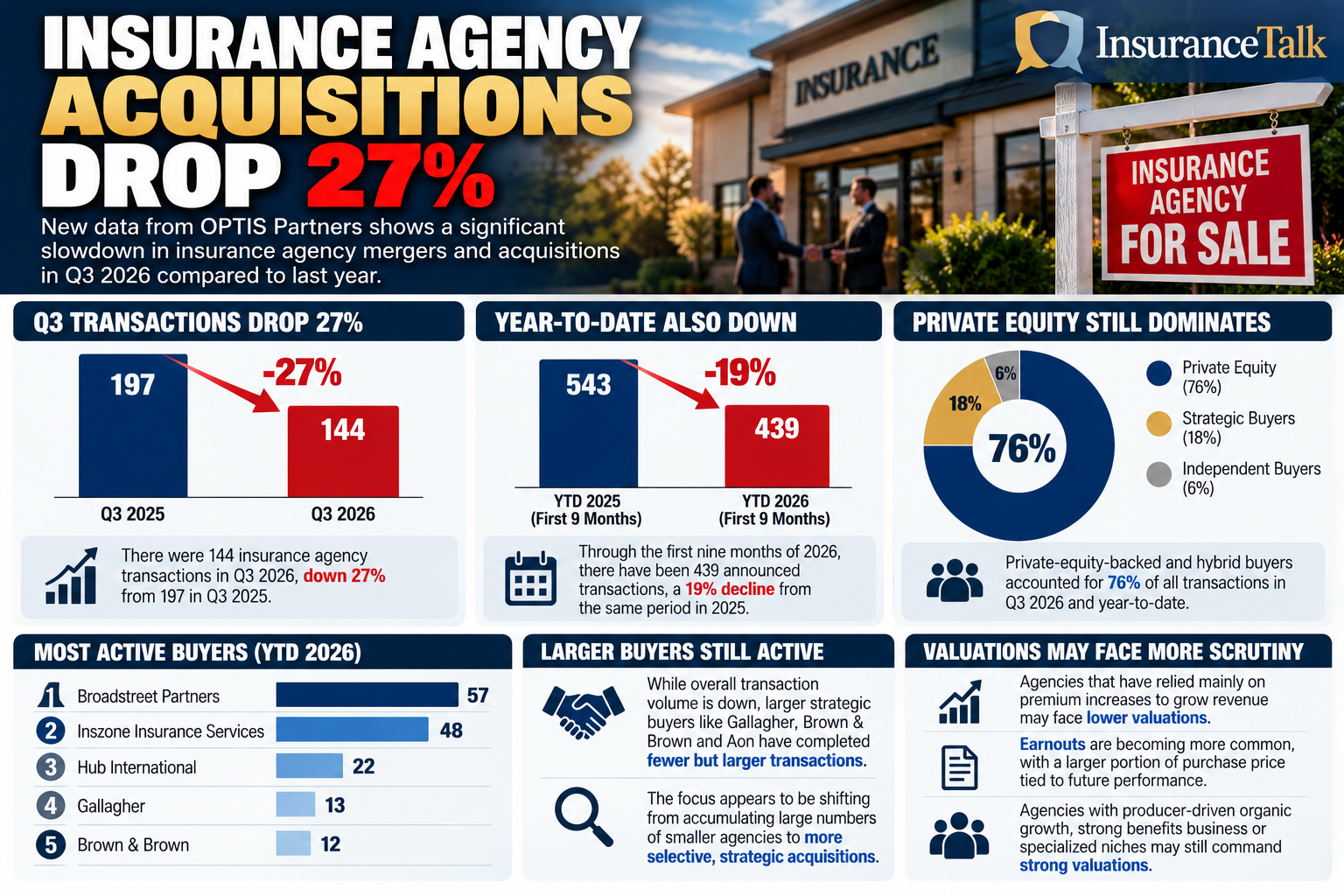
According to a new report from OPTIS Partners, insurance agency mergers and acquisitions dropped 27% during the third quarter of 2026, compared to the same period last year.
There were 144 transactions during the quarter, down from 197 in the third quarter of 2025.
And this isn't just a one-quarter decline.
Through the first nine months of 2026, there have been 439 announced transactions, representing a 19% decline from the same period in 2025.
That's a pretty significant slowdown for an industry that has become accustomed to consolidation.
Private Equity Is Still Doing Most of the Buying
Despite the decline in transactions, private equity remains the dominant force in insurance agency acquisitions.
OPTIS reports that private-equity-backed and hybrid buyers accounted for 76% of transactions during the third quarter and through the first nine months of the year.
So private equity hasn't abandoned the insurance business.
What's changing is how aggressively these companies are pursuing acquisitions.
Many of the larger organizations have spent years accumulating agencies, often financing those purchases with borrowed money.
Now some are facing pressure to pay down debt, integrate the agencies they've already purchased and prepare for future sales or exits.
That makes sense.
You can only buy so many businesses before you eventually have to figure out how to make them work together.
And with borrowing costs and financial expectations playing a role, buying another agency simply for the sake of getting bigger may not be as attractive as it once was.
Some Buyers Are Still Very Active
The slowdown hasn't affected every buyer equally.
According to OPTIS, Broadstreet Partners led the industry with 57 acquisitions through the first nine months of 2026.
Inszone Insurance Services followed with 48 transactions, while Hub International completed 22.
Other major brokerage organizations, including Gallagher, Brown & Brown and Aon, have completed fewer acquisitions, but have pursued some much larger transactions.
This is an important distinction.
A decline in the number of acquisitions doesn't necessarily mean the amount of money being invested in insurance agencies is falling at the same rate.
One large acquisition can represent more money than dozens of smaller agency purchases.
What appears to be changing is the emphasis on buying large numbers of smaller agencies.
Agency Owners May Need to Adjust Their Expectations
This is probably the most interesting part of the report.
OPTIS suggests that agency owners who have relied primarily on insurance premium increases to grow their revenue may have a harder time commanding the valuations they could have received a few years ago.
They may also face larger earnouts.
An earnout is when part of the agency's purchase price depends on how the business performs after the sale.
For example, instead of receiving the entire purchase price at closing, the seller might receive a portion upfront, with additional payments tied to revenue retention or future growth.
That puts more of the risk on the seller.
And I can understand why buyers would want to structure deals that way.
If an agency's revenue increased 15% because insurance premiums went up 15%, that doesn't necessarily mean the agency became a better business.
It may not have written any additional policies.
In fact, it could have lost customers while still showing revenue growth.
That's quite a bit different from an agency that increased revenue by bringing in new clients, improving retention or expanding into additional markets.
And buyers are apparently becoming more selective about that distinction.
Agencies With Real Organic Growth May Still Command Strong Prices
Not all agency owners should interpret these numbers as bad news.
OPTIS believes agencies demonstrating producer-driven organic growth, strong employee benefits business or specialized insurance niches should continue to maintain relatively stable valuations.
In other words, buyers still want good agencies.
They may simply be becoming less willing to pay premium prices for businesses that haven't demonstrated much growth beyond increasing insurance rates.
I think that's a healthy development.
An insurance agency should be valued on its ability to produce revenue, retain customers and generate profits over time.
If a business has built a strong book of business with loyal clients and dependable renewal revenue, it has something valuable.
But if most of its recent growth came from premium inflation, a buyer has every reason to question whether that growth is sustainable.
This could become particularly important if property and casualty insurance premiums begin stabilizing or declining in more markets.
An agency that benefited from several years of premium increases may suddenly find that its revenue isn't growing nearly as quickly.
What About Smaller Independent Agencies?
I think there's another side to this story that deserves some attention.
For years, independent insurance agents have watched larger organizations buy up smaller agencies, sometimes offering purchase prices that would have been difficult for an independent buyer to justify.
Private equity has undoubtedly created opportunities for agency owners who wanted to retire or cash out.
But it has also made it harder for smaller buyers to compete.
If acquisition activity continues to slow, we could eventually see more opportunities for independent agents interested in buying another agency without competing against a private equity-backed organization willing to pay a substantial premium.
That doesn't mean agency prices are suddenly going to collapse.
And there is no indication in this report that private equity is preparing to leave the insurance industry.
But a more disciplined acquisition market could be beneficial for smaller buyers who have been priced out of opportunities.
It might also encourage agency owners to spend more time building their businesses instead of focusing primarily on what they might eventually sell them for.
Is This the Beginning of a Longer Trend?
OPTIS isn't necessarily expecting the slowdown to continue indefinitely.
The firm's representatives indicated that acquisition activity has been slower than anticipated this year, but they believe the fourth quarter could be more active.
That wouldn't be surprising. Acquisition activity often picks up toward the end of the year as buyers and sellers work to complete transactions.
Still, I wouldn't overlook the significance of a 27% quarterly decline.
Private equity has been one of the biggest forces reshaping the independent insurance agency business.
If these organizations are beginning to focus more on profitability, debt reduction and integrating their existing acquisitions, that could change the market for agency owners considering a sale.
And frankly, I don't think that would necessarily be a bad thing.
The Bottom Line
The insurance agency acquisition market is still active, and private equity continues to account for most of the transactions.
But the days of seemingly unlimited appetite for agency acquisitions may be coming to an end.
Buyers appear to be paying closer attention to how an agency generates its revenue and whether its growth is sustainable.
For agency owners, the lesson is fairly straightforward.
Building an agency with loyal clients, consistent new business production and strong renewal retention is still the best way to create long-term value.
Whether you eventually decide to sell the business or keep it, those fundamentals matter.
And if the acquisition market is finally becoming a little more selective, I suspect the agencies that have been doing things right all along will be just fine.
Source: OPTIS Partners, as reported by Insurance Journal