

A new study finds that Medicare Advantage plans eliminating broker commissions experienced a significant decline in enrollment. Researchers say it demonstrates the influence of financial incentives.
For years, insurance agents have been told that their commissions create a conflict of interest when helping Medicare beneficiaries select coverage.
Now we have some research that appears to support that argument.
But I think the findings raise some other questions that deserve just as much attention.
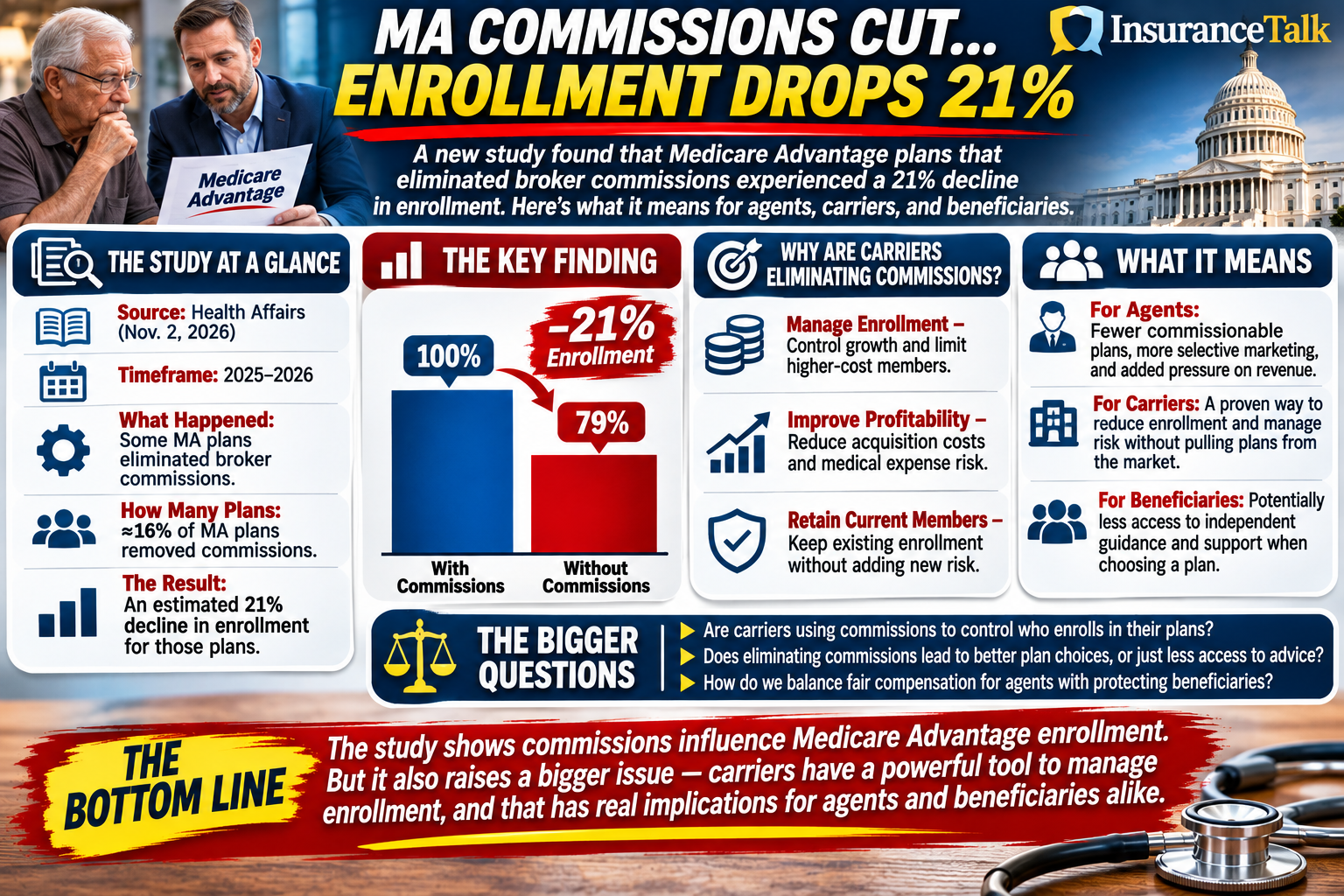
A new study published November 2 in Health Affairs found that Medicare Advantage plans eliminating broker commissions experienced a 21% decline in enrollment, relative to what researchers estimated would have occurred had those commissions remained in place.
That's a pretty significant number.
And considering the number of Medicare Advantage carriers that have been eliminating commissions on certain plans, the findings are particularly relevant to independent insurance agents.
But before we jump to conclusions about what this means, let's look at what actually happened.
Carriers Stop Paying Commissions. Enrollment Falls.
The study, conducted by Jeffrey Marr and David J. Meyers of Brown University, examined Medicare Advantage enrollment during 2025 and 2026.
During that period, several insurance carriers announced that certain Medicare Advantage plans would no longer pay broker commissions for new enrollments.
According to the researchers, approximately 16% of Medicare Advantage plans eliminated broker commissions during late 2025 and early 2026.
Using plan-level enrollment data, the researchers compared enrollment trends between plans that eliminated commissions and those that continued paying them.
Their analysis found that removing commissions resulted in an estimated 21% decline in enrollment between mid-2025 and January 2026.
To be clear, that doesn't mean Medicare Advantage enrollment nationwide declined by 21%.
It means the affected plans experienced an estimated 21% enrollment reduction attributable to the removal of commissions, compared with the researchers' statistical counterfactual.
The researchers concluded that broker financial incentives play an important role in influencing beneficiaries' enrollment decisions.
And they're probably right.
But I think there's a bigger story here.
Why Were Carriers Eliminating Commissions in the First Place?
This is the question I would like to see receive more attention.
Why would an insurance company deliberately eliminate the commissions paid to the very people responsible for bringing it new customers?
Think about that.
Insurance companies spend enormous amounts of money advertising their products and acquiring new members.
Yet some of these same companies have decided they no longer want to compensate independent agents for enrolling beneficiaries into certain plans.
Does that make sense?
Actually, it does.
If you're an insurance company trying to control medical expenses and improve profitability, reducing new enrollment can be an effective strategy.
Particularly if you're concerned that newly enrolled members could generate more medical expenses than the company expects to receive in Medicare payments.
And that's one of the possibilities the researchers themselves acknowledged.
Carriers may have wanted to retain their existing members without attracting additional beneficiaries who could be less profitable.
In other words, eliminating broker commissions may not have been simply a cost-cutting measure.
It may have been a way to manage enrollment.
And if that's the case, the strategy appears to have worked.
Are Agents Steering Clients Away From Non-commissionable Plans?
Here's where the discussion gets uncomfortable.
The researchers suggest that the decline in enrollment indicates brokers responded to financial incentives by directing beneficiaries toward plans that continued paying commissions.
That's certainly one possible explanation.
And I won't pretend that financial incentives have no influence on the behavior of insurance agents.
They do.
Agents are running businesses, and businesses need revenue to survive.
But I also think we need to be careful about assuming every beneficiary who didn't enroll in a noncommissionable plan was somehow steered away from it.
There are other factors worth considering.
When carriers eliminate commissions, agents may become less willing to spend time marketing those plans, prospecting for new customers or providing ongoing service without compensation.
That doesn't necessarily mean an agent recommended an inferior product.
It may simply mean fewer beneficiaries were introduced to that particular plan through the independent agent distribution channel.
There's a difference.
And it's an important one.
The study demonstrates that removing commissions affects enrollment. It doesn't establish that the beneficiaries who enrolled elsewhere received worse coverage or that agents knowingly recommended unsuitable plans.
Those are separate questions.
The Independent Agent Is Not a Volunteer
I think this is something that gets lost in these discussions.
Independent insurance agents are expected to provide a tremendous amount of service.
We help beneficiaries compare plans, review prescription drug formularies, verify provider networks, explain benefits and navigate enrollment rules.
And that's just the beginning.
Once the enrollment is complete, the phone calls don't stop.
Clients need help understanding bills, resolving coverage problems, finding providers and dealing with all kinds of issues that come up throughout the year.
That service has value.
But apparently, some people believe insurance agents should provide it without compensation.
I'm not sure how that's supposed to work.
An independent agent has expenses just like any other business.
Licensing, continuing education, errors and omissions insurance, technology, marketing, transportation and office expenses all cost money.
And unlike captive employees, independent agents generally aren't receiving a salary from an insurance company.
If carriers stop paying commissions, somebody still has to pay for the work.
Or the work simply doesn't get done.
That's not an argument for recommending a plan based on compensation.
It's an argument for recognizing that professional guidance has a cost.
 …
There's Another Side to This: Carrier Influence
One thing I find particularly interesting is the amount of control insurance carriers have over the independent agent distribution system.
Carriers decide which plans they offer.
They determine benefits, premiums and provider networks.
They also decide which plans they'll compensate agents for selling.
And as this study suggests, those compensation decisions can significantly influence enrollment.
So here's my question.
If a carrier can reduce enrollment by 21% simply by eliminating commissions, isn't that a pretty powerful way to control who enrolls in its plans?
Consider what that means.
A carrier doesn't necessarily have to withdraw a plan from the market or stop accepting applications.
It can leave the plan available while removing the financial incentive for independent agents to actively market it.
The plan remains technically available to beneficiaries.
But the number of people enrolling could decline substantially.
That's an interesting dynamic.
And it raises questions about whether carriers are using broker compensation as a tool to manage enrollment and profitability.
The study doesn't prove that every carrier eliminating commissions was attempting to discourage enrollment.
But the possibility deserves serious consideration.
Especially as Medicare Advantage carriers continue adjusting their businesses in response to rising medical utilization and financial pressure.
What About the Beneficiary?
This is where I think the discussion ultimately needs to go.
The purpose of Medicare Advantage isn't to maximize insurance company profits.
And it certainly isn't to maximize agent commissions.
The purpose is to provide healthcare coverage to Medicare beneficiaries.
So the question we should be asking is whether eliminating broker commissions improves or harms the beneficiary experience.
Does it result in better plan selections?
Does it reduce inappropriate enrollments?
Or does it simply reduce access to independent guidance?
Those are important questions.
A Medicare beneficiary choosing between several different plans may need help understanding provider networks, prescription drug coverage, prior authorization requirements and out-of-pocket exposure.
These aren't always simple decisions.
And while beneficiaries can enroll directly through carriers or Medicare, that doesn't necessarily mean they're receiving independent advice.
An insurance company representative is generally there to discuss the company's own products.
An independent broker may be able to compare products from multiple carriers.
That distinction matters.
Of course, independent agents also have a responsibility to disclose relevant information and make recommendations based on the beneficiary's needs.
If an agent deliberately avoids recommending a suitable plan solely because it doesn't pay a commission, that's a problem.
But removing compensation from the equation doesn't automatically make the enrollment process better.
It may just make independent advice harder to obtain.
Should CMS Get Involved?
I suspect this study will eventually become part of the broader discussion surrounding Medicare Advantage broker compensation.
Some policymakers have argued that commission structures create conflicts of interest and should be more tightly regulated.
And there are legitimate concerns worth examining.
But I would caution against assuming that additional government intervention is automatically the solution.
CMS already regulates Medicare Advantage agent compensation and marketing practices.
Agents must complete annual certifications, comply with marketing requirements and follow rules governing beneficiary communications and enrollments.
Adding more restrictions without understanding the consequences could create additional problems.
For example, if compensation becomes so unattractive that fewer independent agents are willing to serve Medicare beneficiaries, who fills that gap?
The insurance carriers themselves?
Large call centers?
Government-sponsored counseling programs?
There may be a role for all of those options.
But I don't think reducing the availability of independent professional advice should be considered a victory.
And I certainly don't think we should ignore the role insurance carriers play in determining which products receive distribution support.
If we're going to discuss financial incentives, let's discuss all of them.
Not just the ones affecting agents.
The Bigger Picture for Medicare Advantage
The Medicare Advantage industry is going through a significant adjustment.
Carriers are dealing with higher medical expenses, changes to risk adjustment, benefit reductions and pressure to improve profitability.
Some have reduced their geographic footprints.
Others have eliminated plans, reduced supplemental benefits or stopped paying commissions on certain products.
None of these decisions happen in a vacuum.
And I think this study provides another piece of evidence that the relationship between carriers, independent agents and beneficiaries is changing.
For years, carriers relied heavily on independent agents to grow their Medicare Advantage membership.
Now some of those same companies appear to be using compensation decisions to discourage additional enrollment in certain products.
That's a remarkable shift.
And it creates an interesting situation for agents who have spent years building relationships with those carriers and their members.
The Bottom Line
The Health Affairs study provides compelling evidence that insurance agent compensation influences Medicare Advantage enrollment.
A 21% reduction is too significant to dismiss.
But I think it would be a mistake to interpret the findings as proof that independent agents are simply chasing commissions.
The study doesn't tell us whether beneficiaries who enrolled in other plans were better or worse off.
It doesn't establish whether those plans had better benefits, stronger provider networks or more affordable prescription drug coverage.
And it doesn't fully answer why carriers decided to eliminate commissions in the first place.
Those questions matter.
I believe independent insurance agents provide an important service to Medicare beneficiaries.
And I also believe agents should be compensated for that service.
That doesn't excuse inappropriate recommendations or conflicts of interest.
But it does recognize a basic economic reality.
When you stop paying people to perform a service, you shouldn't be surprised when less of that service gets performed.
What concerns me more is the possibility that carriers are increasingly using agent compensation as a way to manage enrollment without actually withdrawing products from the market.
If that's happening, it deserves just as much scrutiny as the financial incentives affecting agents.
Because at the end of the day, the beneficiary should come first.
Not the carrier.
Not the agent.
And not the government's latest theory about how Medicare enrollment ought to work.
Source: Jeffrey Marr and David J. Meyers, Brown University. Removal of Medicare Advantage Broker Commissions Associated With a 21 Percent Enrollment Decline, 2025–26. Health Affairs, November 2, 2026.