
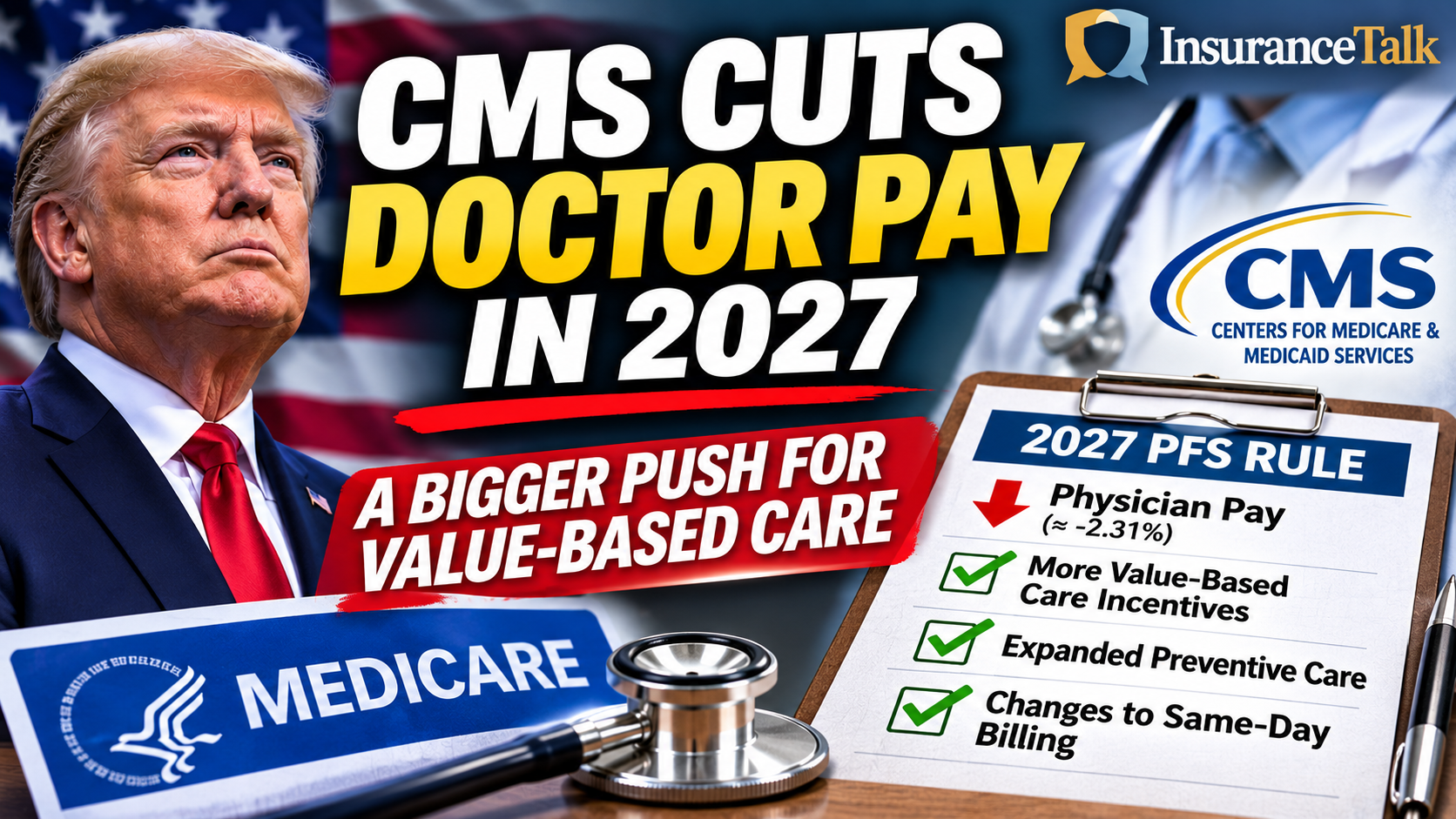
CMS is reducing physician reimbursement in 2027 while offering new incentives for preventive care and better patient outcomes. The goals make sense. But will the changes actually improve healthcare, or just make it harder for doctors to see Medicare patients?
The Trump administration is making some significant changes to the way Medicare pays physicians, and depending on which side of the examination table you're sitting on, the news could be either encouraging or concerning.
On November 4, the Centers for Medicare & Medicaid Services (CMS) finalized its 2027 Medicare Physician Fee Schedule, introducing new payment policies designed to shift Medicare away from simply paying for medical services and toward rewarding better patient outcomes.
That sounds like a reasonable objective.
But there's a catch.
Most physicians are going to receive less money under Medicare's basic payment formula next year.
And while the administration is promoting the changes as part of its broader effort to improve healthcare and control spending, physicians are warning that additional reimbursement reductions could make an already difficult situation worse.
I think both sides have a point.
Medicare Physician Payments Are Dropping in 2027
Under the new rule, Medicare's conversion factor, which is used to calculate physician reimbursement, will decline for 2027.
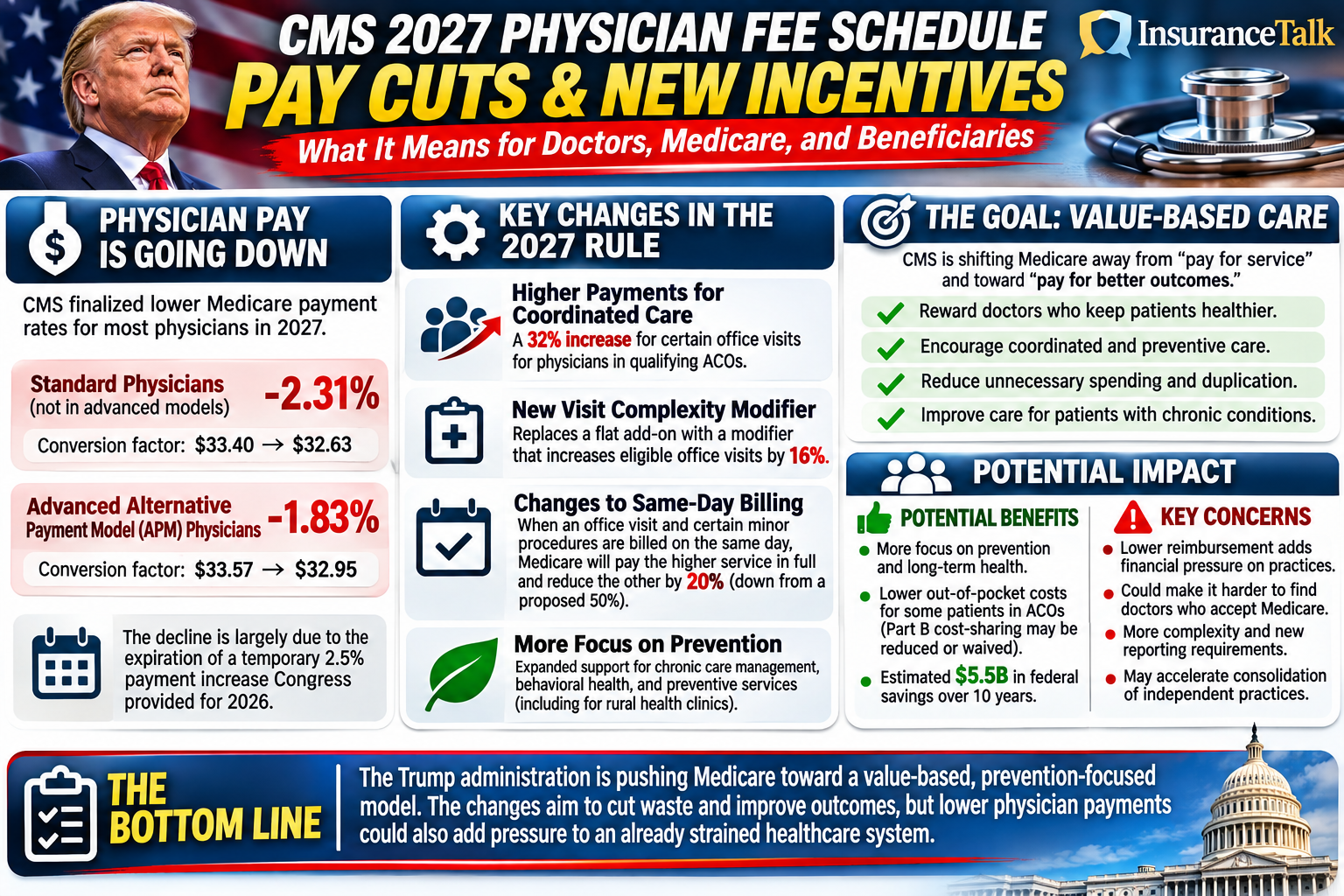
For most physicians who do not qualify under an advanced alternative payment model, the conversion factor will decrease from $33.40 to $32.63.
That's a 2.31% reduction.
Physicians participating in qualifying advanced alternative payment models will see a smaller reduction of 1.83%, with their conversion factor declining from $33.57 to $32.95.
These reductions don't necessarily mean every doctor will receive exactly 2.31% less for every service. Actual reimbursement depends on the services performed, their assigned values and other payment adjustments.
Still, the overall direction is clear.
Medicare's basic physician payment rates are moving lower.
An important detail is that much of this reduction comes from the expiration of a temporary 2.5% payment increase Congress provided for 2026 under President Trump's tax and spending legislation.
That temporary increase expires at the end of this year.
So while CMS is implementing the lower rates, the reductions are largely the result of existing federal law rather than a new, across-the-board cut created solely by CMS.
But that distinction probably won't mean much to a physician trying to pay employees, rent, insurance and other operating expenses.
Those costs aren't going down.
Washington Wants to Pay for Results Instead of Services
The bigger story may be what CMS is trying to accomplish with the new payment structure.
For decades, Medicare has largely operated under a fee-for-service system.
A physician sees a patient, performs a service and submits a claim.
The more services performed, the more opportunities there are to generate revenue.
There's nothing inherently wrong with paying doctors for the work they do.
But the system doesn't always provide much financial incentive to keep patients healthy enough that they don't need those services in the first place.
That's what the Trump administration says it wants to change.
CMS is expanding financial incentives for physicians who participate in accountable care organizations (ACOs), coordinate patient care and focus on preventing chronic conditions from becoming more serious.
One significant change involves additional reimbursement for physicians participating in certain ACO arrangements.
Under the new rule, qualifying physicians will be eligible for a 32% increase to the payment for certain office visits through a new billing modifier.
CMS is also replacing an existing flat-rate visit complexity add-on with a modifier that increases eligible office visit payments by 16%.
These increases aren't universal physician raises. They apply to specific qualifying services and circumstances.
But the message is clear.
Washington wants to direct more money toward physicians who manage patients over time, coordinate treatment and participate in payment arrangements that emphasize quality and cost.
And there's something to be said for that approach.
If a primary care physician can help a diabetic patient avoid hospitalization through better disease management, shouldn't the system recognize the value of that work?
I think so.
The question is whether the government can accurately measure that value without creating another administrative nightmare.
The Trump Administration Is Putting Prevention at the Center of Medicare
The changes also reflect the administration's broader Make America Healthy Again initiative.
Rather than focusing exclusively on treating illnesses after they develop, CMS wants Medicare to place greater emphasis on prevention, chronic disease management and healthier lifestyles.
The new rule includes additional support for behavioral healthcare, shared medical appointments and coordinated treatment for patients with chronic conditions.
It also expands certain preventive services available through rural health clinics.
This is an area where I think the administration deserves some credit.
For years, we've watched healthcare spending continue to increase while chronic diseases remain an enormous problem.
Diabetes, obesity, heart disease and other chronic conditions account for a substantial amount of healthcare utilization.
Yet much of our healthcare system is built around treating the consequences rather than addressing the underlying problems.
I'm not suggesting that better nutrition and exercise will eliminate the need for medical treatment.
Of course they won't.
But it seems reasonable that encouraging healthier lifestyles and intervening earlier could reduce some of the long-term costs associated with chronic disease.
And if Medicare can accomplish that while improving beneficiaries' quality of life, that's a worthwhile goal.
The challenge will be proving that these new payment incentives actually produce better outcomes.
CMS Is Also Targeting Duplicate Payments
Another part of the rule addresses situations where physicians bill Medicare for an office visit and a medical procedure performed on the same day.
CMS argues that some of the work involved in those services may overlap, resulting in duplicate reimbursement.
Under the finalized policy, when a qualifying office visit and certain minor procedures are billed together, Medicare will pay the more expensive service in full and reduce payment for the other service by 20%.
The original proposal called for a 50% reduction.
After receiving feedback from healthcare providers, CMS scaled that back considerably and narrowed the types of procedures affected.
I think it's reasonable for Medicare to examine whether it's paying twice for the same work.
Fraud, waste and abuse have been major problems throughout the program, and taxpayers shouldn't be paying for services that weren't actually provided or for work that's already included in another payment.
But there's an important distinction here.
A legitimate office visit and a legitimate medical procedure aren't necessarily duplicate services simply because they happened on the same day.
Sometimes a patient needs both.
And if the payment reduction discourages physicians from treating patients during the same appointment, Medicare could end up creating additional costs and inconveniences instead of eliminating them.
That's something CMS needs to watch closely.
Doctors Are Already Warning About the Consequences
Not surprisingly, physician organizations aren't particularly enthusiastic about the reimbursement reductions.
The Medical Group Management Association (MGMA) has criticized the final rule, arguing that additional payment cuts will place more financial pressure on medical practices already struggling with rising operating costs.
The organization is also concerned that reducing payments for same-day services could interfere with efficient patient care.
Those concerns shouldn't be dismissed.
Independent physician practices face many of the same financial challenges as other small businesses.
They have employees to pay, insurance premiums, equipment expenses and facilities to maintain.
And unlike many other businesses, they don't have the freedom to simply raise prices when Medicare decides to reduce reimbursement.
The government determines what Medicare will pay.
That's a pretty significant amount of control over a private business.
And it's one of the reasons I remain skeptical of the idea that Washington can continually reduce reimbursement while expecting physicians to maintain the same level of access and service.
Eventually, something has to give.
Could This Make It Harder for Seniors to Find Doctors?
This is probably my biggest concern with the new rule.
Medicare beneficiaries are already experiencing difficulty finding certain physicians who accept their coverage.
In some markets, patients have limited choices for specialists or face lengthy waits for appointments.
Reducing physician reimbursement isn't likely to make Medicare patients more financially attractive to medical practices.
That doesn't mean doctors will suddenly stop accepting Medicare in large numbers.
But if reimbursement continues to fall behind operating costs, some practices may become more selective about accepting new Medicare patients.
Others may consolidate with larger healthcare organizations that have the resources to absorb lower margins.
And that brings us to another issue.
We've spent years watching independent medical practices disappear into large hospital systems and corporate healthcare organizations.
Do we really want federal reimbursement policies that make it even harder for independent physicians to compete?
I don't.
Competition matters in healthcare just as it does in every other industry.
When patients have more choices, providers have greater incentive to compete on quality, service and accessibility.
And when independent practices disappear, those choices can become more limited.
Value-Based Care Isn't Necessarily a Bad Thing
I want to be clear about something.
I'm not opposed to value-based care.
In fact, I think the concept makes quite a bit of sense.
Paying healthcare providers based partly on the quality and effectiveness of their care seems preferable to a system that rewards nothing more than the number of services performed.
But value-based care has been discussed in Washington for years.
It's not a new idea, and it didn't begin with the Trump administration.
We've seen various programs, reporting requirements, quality measures and financial incentives introduced under both Republican and Democratic administrations.
Some have produced encouraging results.
Others have added layers of complexity without necessarily delivering the improvements everyone expected.
The 2027 rule continues that transition.
CMS is also moving toward eliminating the traditional Merit-based Incentive Payment System (MIPS) reporting option beginning with the 2031 performance year, giving physicians additional time to transition into newer quality-reporting pathways or alternative payment models.
Reducing unnecessary reporting requirements would be welcome.
But replacing one complicated government program with another complicated government program isn't necessarily progress.
And I think the administration needs to be careful not to confuse more sophisticated reimbursement formulas with better healthcare.
They're not always the same thing.
There's Also a Potential Benefit for Medicare Beneficiaries
One provision that hasn't received nearly as much attention could directly benefit some Medicare patients.
Beginning April 1, 2027, qualifying ACOs will have the option to reduce or eliminate Medicare Part B cost-sharing for certain services provided to beneficiaries assigned to their organizations.
That could mean lower out-of-pocket expenses for eligible patients receiving care through participating providers.
It's not an across-the-board elimination of Medicare copayments or coinsurance.
But it could encourage patients to seek necessary care earlier instead of postponing treatment because of the cost.
CMS also projects that its changes to the Medicare Shared Savings Program could generate approximately $5.5 billion in net federal savings over ten years.
Those are projections, not guaranteed savings.
But if the program can reduce unnecessary spending while maintaining or improving healthcare quality, that's certainly something worth pursuing.
Especially considering Medicare's long-term financial challenges.
The Bigger Question: Can Government Actually Engineer Better Healthcare?
Here's where I think we need to be careful.
I support the Trump administration's efforts to address wasteful spending, encourage preventive healthcare and bring greater accountability to Medicare.
Those are legitimate objectives.
And frankly, they're long overdue.
But I'm also a believer in free markets and competition.
Government has a pretty poor track record of accurately determining what goods and services should cost.
Healthcare is no exception.
Medicare already relies on an extraordinarily complicated reimbursement system that assigns values to thousands of medical services.
Now we're adding additional incentives, modifiers and payment adjustments designed to influence how physicians practice medicine.
Maybe some of those changes will work.
I hope they do.
But we should also recognize that physicians are responding to financial incentives created by Washington rather than prices established through ordinary market competition.
When those incentives are wrong, the consequences can be significant.
And the people who ultimately pay the price are often the patients.
The Bottom Line
The Trump administration's 2027 Medicare Physician Fee Schedule represents another major step toward value-based healthcare.
It places greater emphasis on prevention, chronic disease management, coordinated treatment and reducing unnecessary spending.
Those are goals I can support.
And I give the administration credit for trying to address some of the underlying problems that have contributed to rising healthcare costs.
But reducing physician reimbursement while expecting better access and higher-quality care is a difficult balancing act.
We cannot continue squeezing independent medical practices and then act surprised when patients struggle to find doctors.
Medicare doesn't save money if beneficiaries can't get the healthcare they need. It simply shifts the consequences somewhere else.
I would like to see the Trump administration succeed in making Medicare more efficient.
Not by creating another layer of bureaucracy, but by eliminating unnecessary spending, rewarding legitimate improvements in patient outcomes and giving physicians more freedom to practice medicine.
The real measure of success won't be how much money CMS projects it can save.
It will be whether Medicare beneficiaries are healthier, whether they can still find doctors willing to treat them, and whether taxpayers are getting better value for the money being spent.
That's the standard we should be using.
And it's one Washington should take seriously.
Sources: