

SelectQuote reported a sharp decline in final expense production during its latest quarter, even as its life insurance division improved profitability. The numbers raise some interesting questions about the future of final expense distribution.
Final expense insurance has long been considered one of the more dependable markets in the life insurance industry.
People are always getting older. Funeral expenses aren't getting any cheaper. And there will always be families who haven't put enough money aside to cover those expenses.
So when one of the country's larger insurance distributors reports a 32% decline in final expense premiums, it's worth paying attention.
That's exactly what SelectQuote reported in its fiscal first-quarter 2027 results.
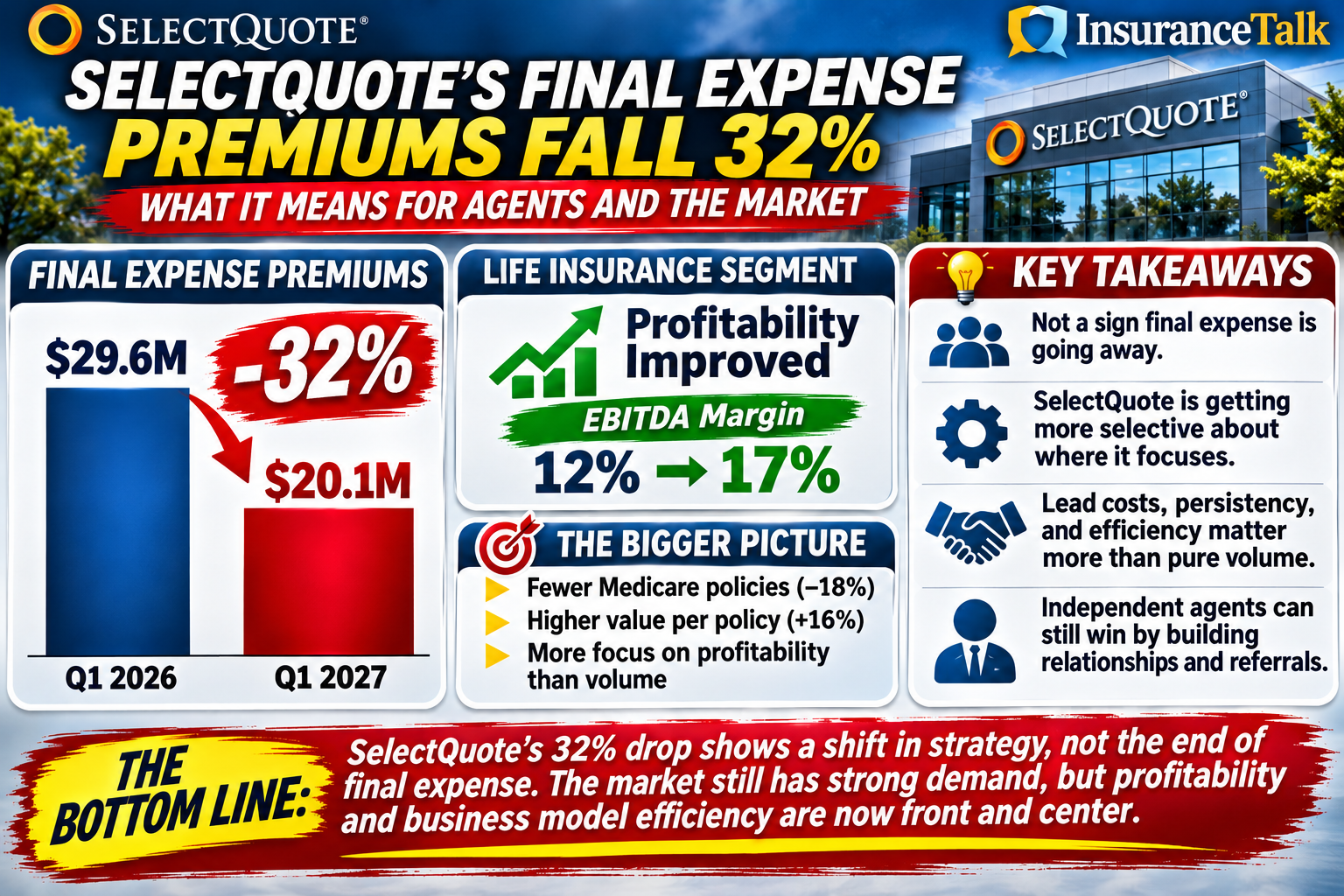
According to financial results discussed in Insurance Business, SelectQuote's final expense premiums fell 32% to $20.1 million, compared with the same quarter last year.
That's a pretty substantial decline.
But here's where the story gets interesting.
Despite the drop in final expense premiums, SelectQuote's overall life insurance segment actually became more profitable.
And I think that tells us something important about the direction large insurance distributors may be heading.
Fewer Final Expense Premiums, Better Profitability
SelectQuote's life insurance division generated $42.8 million in revenue during the quarter.
Its adjusted EBITDA margin increased from 12% a year earlier to 17%.
In other words, the company improved its operating profitability even though its final expense premium production declined significantly.
Now, that doesn't mean the final expense business itself became more profitable.
The reported margin applies to the entire life insurance segment, which also includes other products.
But it does suggest SelectQuote is becoming more selective about where it spends money and how it generates business.
And this isn't happening in isolation.
Across other parts of the company, SelectQuote is deliberately reducing production and concentrating on profitability.
Its Medicare Advantage approved policy volume declined 18%, while the estimated lifetime commission value per approved policy increased 16%.
The company also reduced its senior insurance agent workforce, emphasizing experienced agents and better production economics.
The message seems pretty clear.
SelectQuote is becoming less concerned with how much business it writes and more concerned with how much money it makes on the business it keeps.
That's not necessarily a bad strategy.
In fact, it's how most businesses should operate.
But it raises an interesting question about final expense insurance.
Is SelectQuote pulling back because final expense has become less attractive, or is it simply discovering that writing more policies doesn't always mean making more money?
Final Expense Is a Different Business Than Medicare
Anyone who has sold both Medicare and final expense insurance understands that they're two very different businesses.
Medicare Advantage generally provides agents with an initial commission and ongoing renewal compensation, assuming the enrollment remains eligible and the agent continues meeting applicable requirements.
Final expense is different.
The economics are often much more dependent on upfront commissions, policy persistency and the cost of acquiring customers.
An agent can write a significant amount of final expense premium and still struggle financially if too many policies lapse.
And for larger organizations purchasing leads, operating call centers and paying agents, those expenses can add up quickly.
Consider the economics.
A company spends money generating a lead.
It pays an agent to contact the prospect and complete the application.
There may be underwriting requirements, follow-up calls and additional administrative expenses.
Then, after all that work, the customer has to keep paying the premium.
If the policy lapses early, the company or agent may face commission chargebacks.
That's a lot of financial exposure before a policy becomes consistently profitable.
And if lead costs are increasing or persistency is deteriorating, writing more policies can actually make the situation worse.
I'm not suggesting that's necessarily what happened at SelectQuote.
The company's reported results don't establish that rising lead costs or poor persistency caused the decline.
But those are exactly the kinds of issues I would be examining when evaluating a large final expense operation.
The Lead Business Deserves Some Attention
One thing I believe independent agents should be watching closely is the cost of customer acquisition.
Final expense has become an extremely competitive market.
There are direct-mail campaigns, television advertisements, internet leads, social media campaigns and large call centers competing for the same customers.
And those customers aren't always inexpensive to reach.
An independent agent purchasing leads has to consider more than the cost of the lead itself.
How many leads turn into appointments?
How many appointments turn into applications?
How many applications actually result in issued policies?
And perhaps most importantly, how many of those policies remain in force?
That's where the real economics are determined.
A $20 lead isn't necessarily a bargain if it takes 30 leads to write one policy.
And a $75 lead isn't necessarily expensive if it consistently produces quality business.
The same principle applies to large distributors like SelectQuote, although their acquisition costs and operating models may be very different.
Production volume looks impressive in a quarterly report.
But profitability is what keeps a business operating.
Are Large Call Centers Losing Their Advantage?
I've wondered for some time whether the economics of large insurance call centers would eventually become more challenging.
These organizations can generate tremendous amounts of business.
They have substantial marketing budgets, technology platforms and the ability to reach consumers across the country.
But they also have expenses that smaller independent agencies don't necessarily carry.
Large employee payrolls.
Management teams.
Facilities.
Technology infrastructure.
National advertising campaigns.
And an ongoing need to generate enough sales volume to support the entire operation.
An independent agent working from a small office or visiting clients in their homes may operate with substantially lower overhead.
That doesn't automatically make the independent agent more efficient.
But it does create a different financial model.
A smaller agency doesn't necessarily need thousands of applications every month to be successful.
It needs enough profitable business to cover expenses and generate a reasonable return.
And when you build relationships with clients, referrals can become an important source of new business.
Those referrals don't always require the same marketing expenditure as purchasing another round of internet leads.
I think that's an advantage independent agents shouldn't overlook.
The Final Expense Market Isn't Going Away
I wouldn't interpret SelectQuote's results as evidence that final expense insurance is becoming obsolete.
Far from it.
The underlying need for these products hasn't disappeared.
Many Americans still have limited savings and don't have sufficient life insurance to cover funeral expenses and other final obligations.
And as the population ages, that need isn't likely to disappear anytime soon.
But a market can have strong consumer demand and still become difficult for certain distribution models.
Those are two different things.
For example, a company relying heavily on expensive advertising may struggle to generate acceptable returns while an independent agent working through referrals and personal relationships remains profitable.
The opposite can also happen.
Large organizations may benefit from technology, scale and operational efficiencies that smaller agencies cannot easily replicate.
The point is that a decline in one company's production doesn't necessarily indicate a decline across the entire industry.
And I think that's especially important here.
SelectQuote's 32% decline tells us what happened at SelectQuote. It doesn't tell us that final expense sales nationwide declined 32%.
We would need broader industry data before making that conclusion.
Could This Be the Beginning of a Larger Shift?
What interests me most about these results is that SelectQuote appears to be making similar adjustments across multiple business segments.
The company is producing fewer Medicare Advantage policies.
Its final expense premiums are declining.
And its healthcare services division is also reducing membership while improving profitability.
That's not necessarily the picture of a company desperately trying to increase sales.
It looks more like a company reassessing which business is worth pursuing.
And I suspect we'll see more of this throughout the insurance industry.
For years, growth has been the primary objective for many large distributors.
More leads.
More agents.
More applications.
More premium.
But growth isn't always profitable.
Sometimes the smartest business decision is to stop pursuing customers who cost more to acquire and service than they're likely to generate in revenue.
That may not produce impressive sales numbers.
But it can produce a healthier business.
And that's ultimately what matters.
What Should Independent Final Expense Agents Take Away From This?
I think there's a lesson here for independent agents, particularly those trying to build larger agencies.
Don't become so focused on production that you forget about profitability.
An agency writing $100,000 in annualized premium isn't necessarily more successful than one writing $60,000.
Not if the larger agency is spending most of its revenue on leads, chargebacks and operating expenses.
Persistency matters.
Customer acquisition costs matter.
And building a book of business that stays on the books matters.
I would also encourage agents to pay attention to their distribution methods.
If you're relying entirely on purchased leads, you're dependent on someone else's pricing and lead quality.
That can become an expensive position to be in.
Building referral relationships and developing a reputation in your local market takes time.
But it can also create a business that's less dependent on continually purchasing its next customer.
The Bottom Line
SelectQuote's final expense premiums declined 32% during its latest quarter, falling to $20.1 million.
That's a significant reduction for a major insurance distributor.
But the company's life insurance division improved its adjusted EBITDA margin from 12% to 17%.
And that's what makes this story interesting.
The company is demonstrating that higher production isn't always necessary to improve profitability.
Whether this represents a broader change in the final expense industry remains to be seen.
Personally, I don't believe the final expense market is going anywhere.
There's too much demand for affordable, permanent life insurance among older Americans.
But I do believe the way that business is distributed will continue evolving.
And perhaps the biggest lesson here is one that independent agents should have learned a long time ago.
You don't build a successful insurance agency by writing the most business. You build one by writing profitable business that stays on the books.
Those aren't always the same thing.
Source: Insurance Business — SelectQuote Places Fewer Medicare Policies but Earns More on Each One, reporting SelectQuote's fiscal Q1 2027 financial results.