
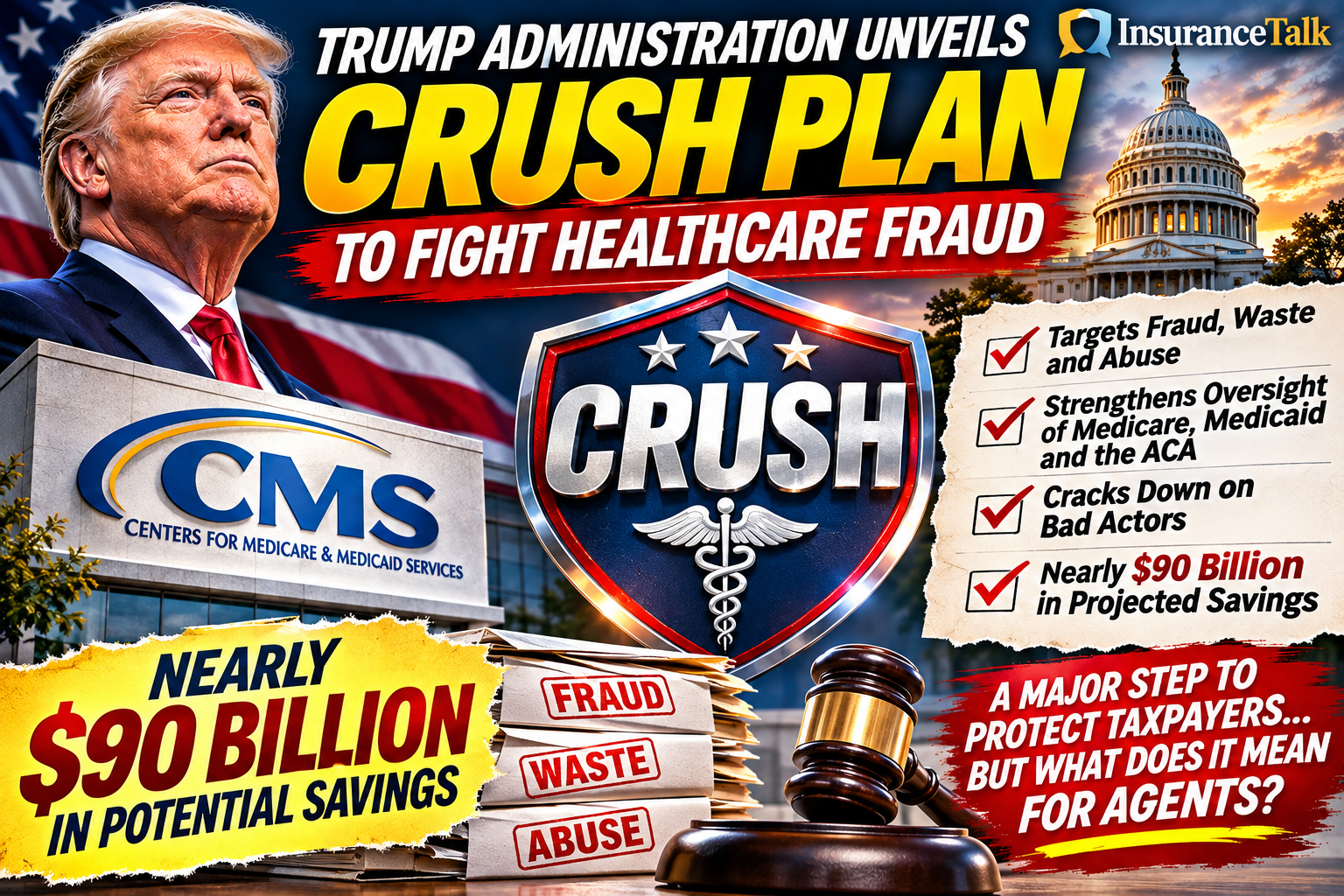
CMS has unveiled its CRUSH proposal, a sweeping effort to combat fraud, waste and abuse across Medicare, Medicaid and the ACA Marketplace. The Trump administration deserves credit for taking the problem seriously. But protecting taxpayers shouldn't mean making life harder for legitimate insurance agents and healthcare providers.
For years, we've watched billions of dollars disappear into fraudulent healthcare claims, questionable Medicare billing practices and unauthorized ACA enrollments.
And for years, Washington's answer has often been another regulation, another reporting requirement or another government program.
Meanwhile, the fraud continues.
Now the Trump administration is proposing something considerably more aggressive.
On November 16, the Centers for Medicare & Medicaid Services (CMS) announced its Comprehensive Regulations to Uncover Suspicious Healthcare proposal, appropriately named CRUSH.
According to CMS, the proposed reforms could save taxpayers nearly $90 billion over the next ten years.
That's a substantial amount of money.
And considering the financial challenges facing Medicare and other federal healthcare programs, it's money we can't afford to waste.
I applaud President Trump and his administration for making fraud, waste and abuse a priority.
But as an independent insurance agent, I also have some concerns about how these new enforcement powers could affect legitimate businesses.
Because there's a big difference between going after criminals and making honest people jump through another dozen government hoops.
Nearly $90 Billion in Potential Savings
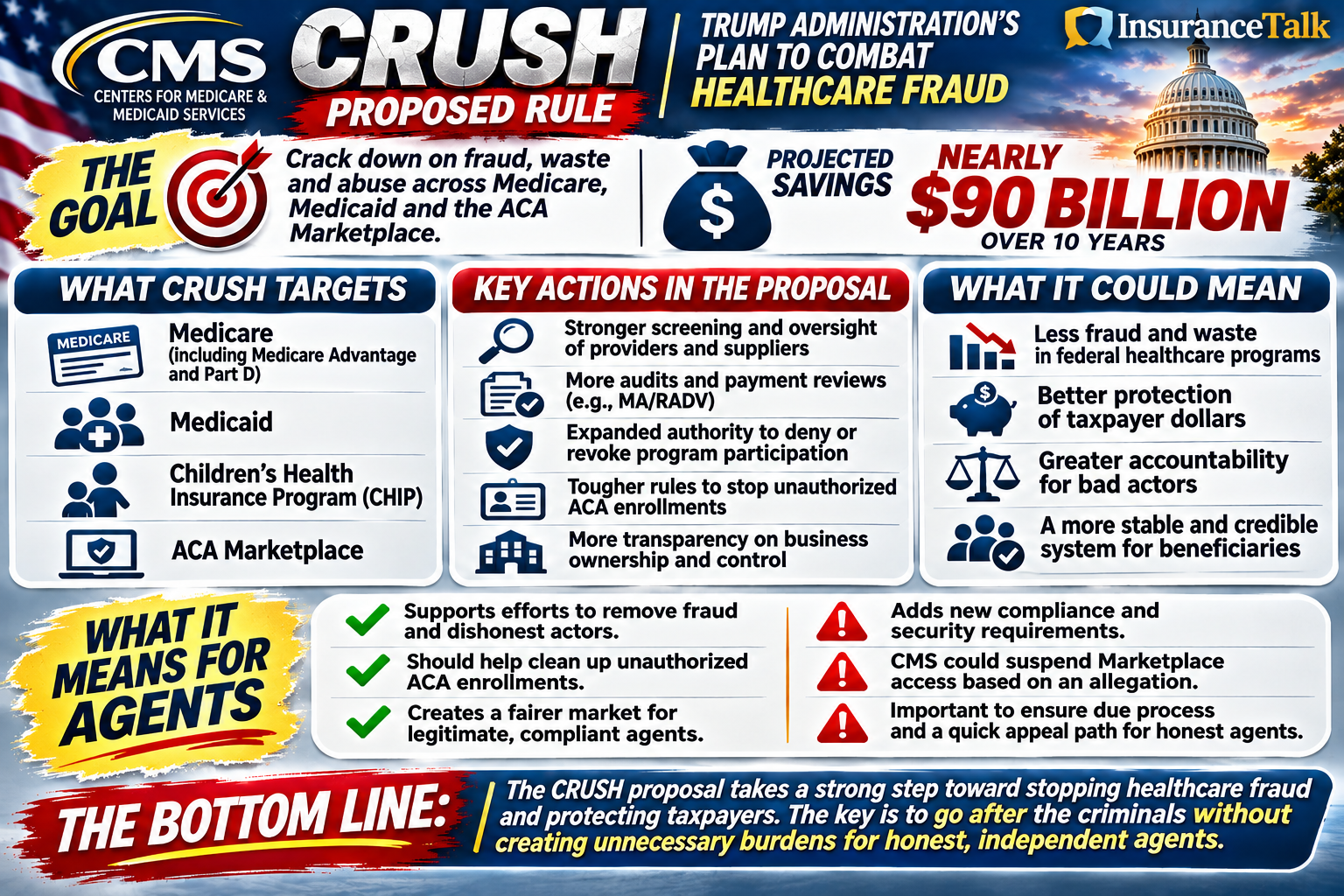
The CRUSH proposal targets fraud across several federal healthcare programs, including Medicare, Medicare Advantage, Part D, Medicaid, the Children's Health Insurance Program and the ACA Marketplace.
The goal is relatively straightforward.
Stop fraudulent payments before the money leaves the government's hands.
That may sound obvious, but historically, much of the government's fraud enforcement has involved identifying improper payments after they've already been made.
Then comes the investigation.
Then the effort to recover the money.
And sometimes, by that point, the people responsible have disappeared.
CMS wants to change that approach.
The proposal would strengthen provider screening, increase oversight of medical suppliers, expand reporting requirements and give CMS greater authority to deny or revoke participation in federal healthcare programs.
It would also require more transparency about who actually owns and operates businesses receiving government healthcare payments.
I think that's reasonable.
If a company is billing Medicare for millions of dollars in medical equipment, CMS ought to know who owns the company.
And if those owners have a history of fraudulent activity, they shouldn't be able to simply open another business and start billing taxpayers again.
One important distinction: the nearly $90 billion represents projected federal savings if the proposal is implemented. It isn't money the government has already recovered, and it shouldn't all be characterized as proven fraud.
Still, the potential savings are significant.
Medicare Advantage Is Getting More Scrutiny
One of the most interesting parts of CRUSH involves Medicare Advantage.
CMS is proposing stronger Risk Adjustment Data Validation audits, commonly known as RADV audits.
For those unfamiliar with the process, Medicare Advantage plans receive payments from the federal government based partly on the health conditions of their enrolled members.
Generally speaking, a beneficiary with more serious medical conditions generates a higher risk-adjusted payment than someone who is relatively healthy.
That makes sense.
A patient with multiple chronic illnesses will typically require more medical care.
But it also creates an opportunity for abuse.
If an insurance company submits diagnoses that aren't supported by medical records, it can potentially receive more money than it's entitled to.
And we're not talking about small amounts of money.
Medicare Advantage has become an enormous industry, with hundreds of billions of dollars flowing through the program annually.
CMS wants to strengthen its ability to identify unsupported diagnoses and recover improper payments.
I support that.
Insurance companies should be paid what they're entitled to receive.
Not a penny more.
And I think it's important that we're finally having a serious discussion about holding large insurance carriers accountable, rather than focusing almost exclusively on individual agents and providers.
If an agent submits a fraudulent enrollment, there should be consequences.
But if a multibillion-dollar insurance company receives improper payments through unsupported diagnosis coding, there should be consequences there too.
Accountability shouldn't depend on the size of the business.
The ACA Marketplace Has a Fraud Problem
Another major component of CRUSH involves the Affordable Care Act Marketplace.
And this is where things become particularly relevant to insurance agents.
We've seen repeated reports of consumers being enrolled in Marketplace plans without their knowledge or consent.
Some have had their existing coverage changed without authorization.
Others have discovered that someone used their personal information to obtain subsidized health insurance.
These aren't harmless paperwork mistakes.
They can create serious problems for consumers, including disrupted coverage, unexpected tax consequences and difficulties accessing healthcare.
And taxpayers are often footing the bill through premium subsidies.
The Trump administration wants to strengthen CMS's ability to suspend or terminate agents and brokers who engage in abusive conduct.
Under the proposal, CMS could immediately suspend an agent's Marketplace agreement based on a credible allegation of abusive conduct that is causing, or likely to cause, harm.
It would also establish additional grounds for terminating agreements and restricting Marketplace access.
On the surface, that sounds reasonable.
Nobody wants fraudulent agents operating in the Marketplace.
But there's a part of this that concerns me.
An Allegation Isn't a Conviction
I believe people who deliberately enroll consumers without permission should lose their ability to participate in the Marketplace.
And depending on the circumstances, criminal prosecution may be appropriate.
But we also need to be careful about giving a government agency the authority to effectively shut down someone's business based on an allegation.
The CRUSH proposal would allow immediate suspension under certain circumstances involving credible allegations of abusive conduct.
Now, I understand why CMS wants that authority.
If an agent is actively enrolling hundreds of consumers without authorization, the government needs a way to stop the activity before more people are harmed.
But what happens when an allegation is incorrect?
What happens when a consumer misunderstands something?
Or when a complaint involves a legitimate enrollment dispute rather than intentional misconduct?
For an independent agent, losing Marketplace access could mean losing the ability to earn a living.
That's not a minor consequence.
There needs to be a clear process for reviewing allegations, presenting evidence and restoring access when an agent has been wrongly accused.
And that process needs to happen quickly.
Protecting consumers is important. Protecting honest businesses from arbitrary government action is important too.
We shouldn't have to choose between the two.
The Trump Administration Deserves Credit, but More Regulation Isn't Always the Answer
I've been encouraged by the administration's willingness to confront healthcare fraud.
CMS reports that Medicare program-integrity savings increased from $26.3 billion in fiscal year 2024 to $41.9 billion in fiscal year 2025.
That's a 59% increase.
The agency also reports a return of $22.30 for every dollar invested in Medicare program-integrity activities during fiscal year 2025.
Those are impressive figures, although the savings measure is broader than criminal fraud recoveries, and the fiscal-year results shouldn't be attributed entirely to one administration.
Still, it's encouraging to see the government paying attention to money going out the door instead of constantly looking for ways to collect more from taxpayers.
And I think this is where conservative principles should guide the discussion.
Government has a legitimate responsibility to protect taxpayer dollars and prosecute fraud.
That's not the same thing as believing government should micromanage every aspect of a private business.
We need enforcement that's targeted, effective and proportionate.
Not a regulatory environment where legitimate providers and insurance agents spend more time proving they aren't criminals than serving their customers.
If CMS can use better data analysis to identify suspicious billing patterns, I'm all for it.
If it can prevent someone with a history of healthcare fraud from opening another medical supply company, excellent.
And if it can stop unauthorized ACA enrollments before subsidies are paid, even better.
But we should be measuring success by the fraud prevented and the taxpayer dollars protected.
Not by how many new regulations Washington can produce.
Independent Agents Shouldn't Be Collateral Damage
There's another provision in CRUSH that deserves attention.
The proposal would require Marketplace agents and brokers to maintain safeguards against access to Marketplace systems from locations outside the United States, including through certain VPN connections.
The objective is understandable. CMS wants to prevent unauthorized access and make it harder for fraudulent operations to exploit the system.
But implementation matters.
An independent agency with two employees doesn't have the same technology department as a national insurance brokerage.
Requirements that are relatively easy for a large organization to implement can become expensive and complicated for a small business.
And we've already seen what happens when fraud prevention becomes too broad.
Earlier this year, CMS attempted to freeze new ACA broker registrations, affecting thousands of agents trying to enter the market. A federal judge subsequently blocked that moratorium.
That's exactly the kind of approach we need to avoid.
Fraud prevention should make it harder for criminals to operate.
It shouldn't make it harder for honest Americans to start an insurance agency.
And there's something else worth remembering.
Independent agents are often the people helping consumers identify problems with their coverage.
We're the ones reviewing unexpected plan changes, investigating unfamiliar enrollments and helping clients understand what happened.
We're part of the solution.
CMS should treat legitimate agents as partners in preventing fraud, not as suspects simply because of the industry we work in.
The Bottom Line
I support the Trump administration's CRUSH initiative.
Medicare and Medicaid are facing enormous financial pressures, and the ACA Marketplace has demonstrated serious vulnerabilities to fraudulent enrollment activity.
We cannot continue allowing criminals to exploit these programs while taxpayers pick up the tab.
The administration deserves credit for addressing the problem aggressively.
But I also believe we need to hold Washington accountable for how these reforms are implemented.
A successful fraud crackdown should protect beneficiaries, recover improper payments and remove dishonest operators from the industry.
It should also preserve due process, encourage competition and avoid imposing unnecessary costs on legitimate small businesses.
Because here's the thing.
You don't strengthen the insurance industry by making it harder for honest agents to do business. You strengthen it by getting the dishonest ones out.
And if the Trump administration can accomplish that while saving taxpayers billions of dollars, I'll be the first to applaud.
Just don't confuse more government regulation with better government.
They're almost always not the same thing.
Here is the official public comment page for the Trump administration's CRUSH proposed rule:
Submit a Public Comment — CMS CRUSH Rule
Comment deadline: January 19, 2027
Rule number: CMS-6098-P
Sources: